MUSIC: IN PROGRESS 💎
CLICK THE COVER ART FOR THE PURCHASE LINK
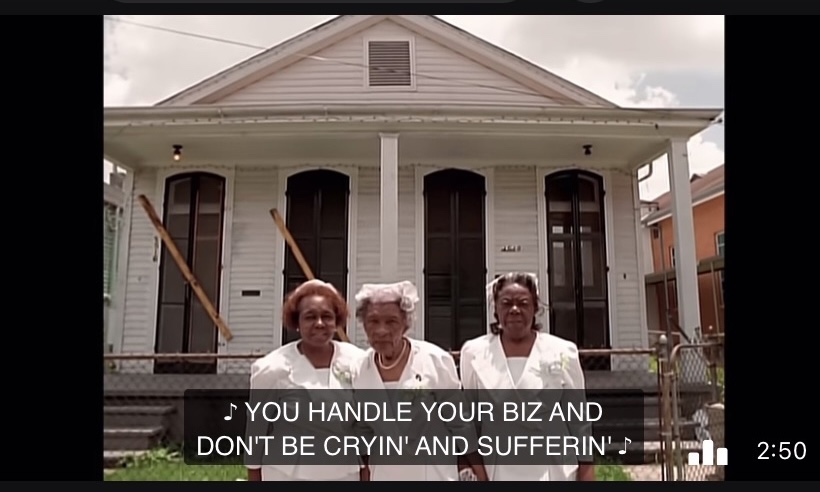
A twitter debate about 400 Degreez vs Reasonable Doubt made me remember both New Orleans and NYC before gentrification. I have a new essay about it for Burnaway’s 2023 Reader: Where I’m Calling From.
Storms, Shakespeare, Juvenile’s “Ha” and a consideration of Simone Leigh’s, Loophole of Retreat Symposium at the Venice Biennale. In it, I’m also thinking through Black artists, writers, thinkers, etc. from below the Mason Dixon Line’s influence on popular culture and contemporary art, —how we show up and when we don’t , and the implications of it all.
On IG live later this week, Thursday, March 30 12:30 CST/ 1:30 EST with MATOU, IMAN PERSON to talk more about Black sonic technologies❤️🔥.

Idk, might write a part 2 for the streets 🔥🔥🔥

Welcome to the AfroFuture:
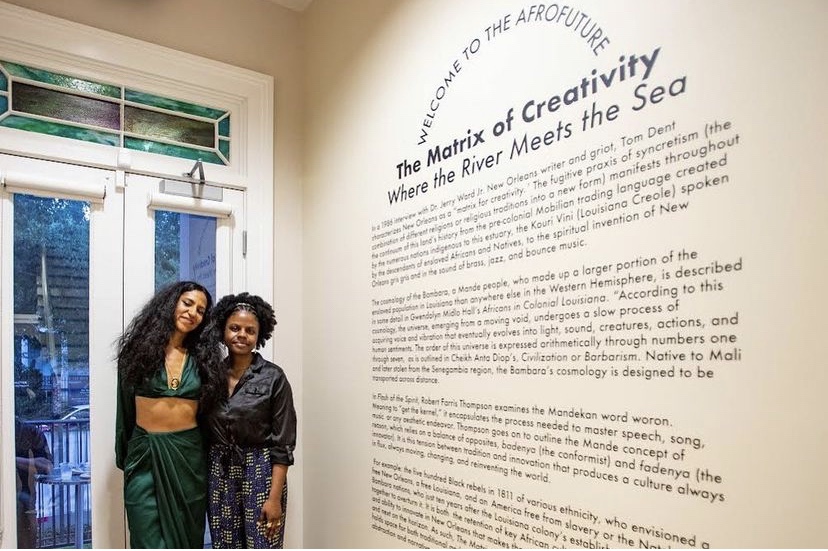
The Matrix of Creativity: Where the River Meets the Sea
curatorial statement
In a 1986 interview, Dr. Jerry Ward Jr. in conversation with New Orleans writer and griot, Tom Dent, characterizes New Orleans as a “matrix for creativity.”
The fugitive praxis of syncretism ( the combination of different religions or religious traditions into a new form) manifests throughout the continuum of this land’s history from the pre-colonial Mobilian trading language created by the numerous nations indigenous to this estuary, the Kouri Vini (Louisiana Creole) spoken by the descendants of enslaved Africans and Natives, to the spiritual invention of New Orleans gris gris and in the sound of brass, jazz, and bounce music.
The cosmology of the Bambara, a Mandé people, who made up a larger portion of the enslaved population in Louisiana than anywhere else in the Western Hemisphere, is described in some detail in Gwendolyn Midlo Hall’s Africans in Colonial Louisiana. “According to this cosmology, the universe, emerging from a moving void, undergoes a slow process of acquiring voice and vibration that eventually evolves into light, sound, creatures, actions, and human sentiments. The order of this universe is expressed arithmetically through numbers one through seven, as is outlined in Cheikh Anta Diop’s, Civilization or Barbarism. Native to Mali and later stolen from the Senegambia region, the Bambara’s cosmology is designed to be transported across distance.
In Flash of the Spirit, Robert Farris Thompson examines the word Mandekan word woron. Meaning to “get the kernel,” it encapsulates the process needed to master speech, song, music, or any aesthetic endeavor. Thompson goes on to outline the Mandé concept of reason, which relies on a balance of opposites, badenya (the conformist) and fadenya (the innovator).
It is this tension between tradition and innovation that produces a culture always in flux, always moving, changing, and reinventing the world. For example: the five hundred Black rebels in 1811 of various ethnicity, who envisioned a free New Orleans, a free Louisiana, and an America free from slavery or the Natchez and Bambara nations, who just ten years after the Louisiana colony’s establishment, conspired together to overturn it. It is both the retention of key African cultural concepts and the space and ability to innovate in New Orleans that makes the city the perpetual site of what’s new and next on the horizon.
As such, The Matrix of Creativity : Where the River Meets the Sea holds space for both traditional and new interpretations of who and what constitutes the work, history, and legacy of Afrofuturism.
SHOW NOTES
Front Hall
(downstairs )


Sokari Ekine
Jameel Paulin
Dianne Baquet
•EKINE’s archives of fire and water mark a spiritual and aesthetic point of origin as well as Paulin’s African Fractals.
• Feliciane and Child, Refugee from San Domingue by Dianne Baquet grounds these ideas in the historical by evoking the arrival of Haitians to New Orleans during and following the revolution.
Back Hall
“the bright earth”

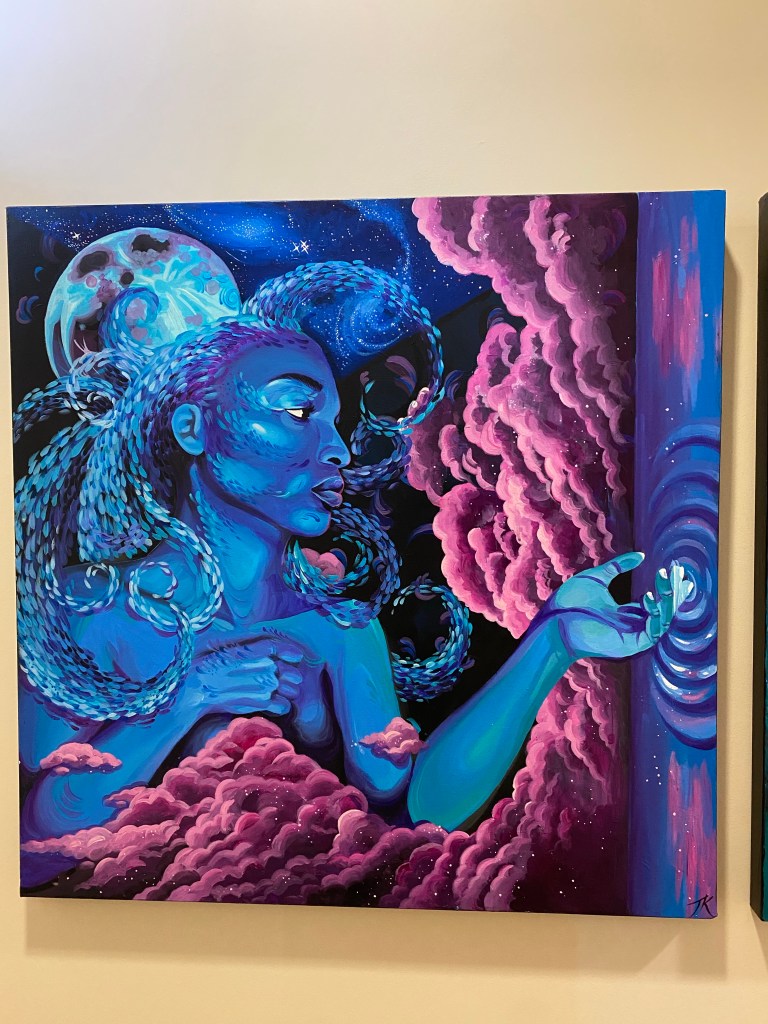

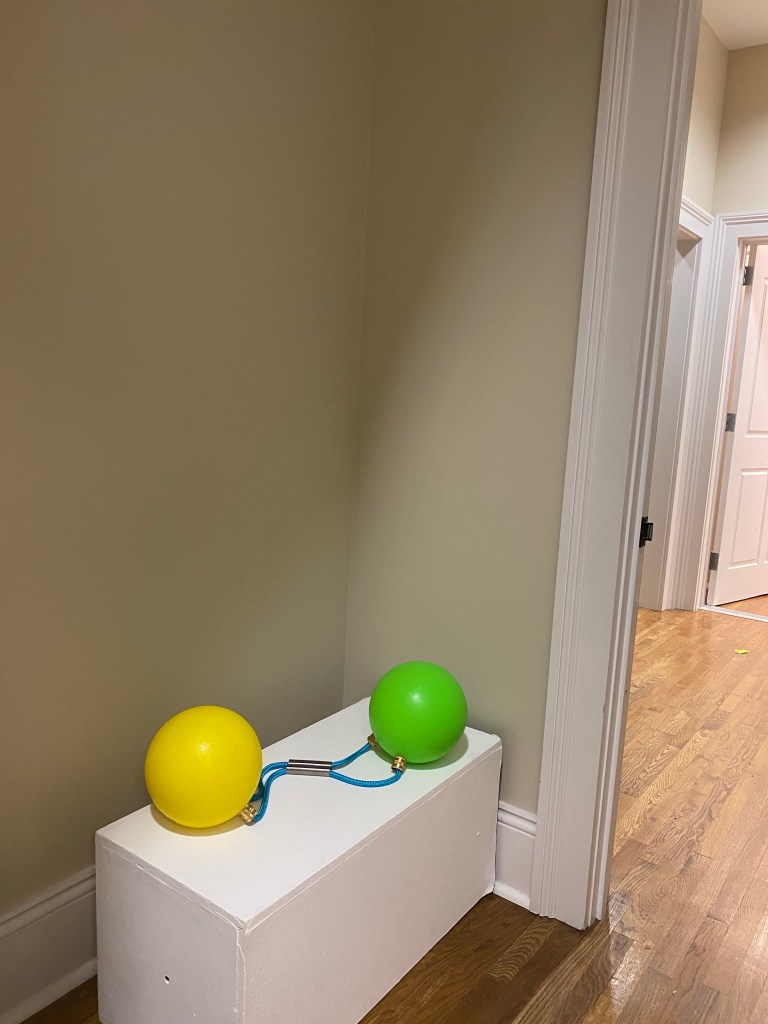

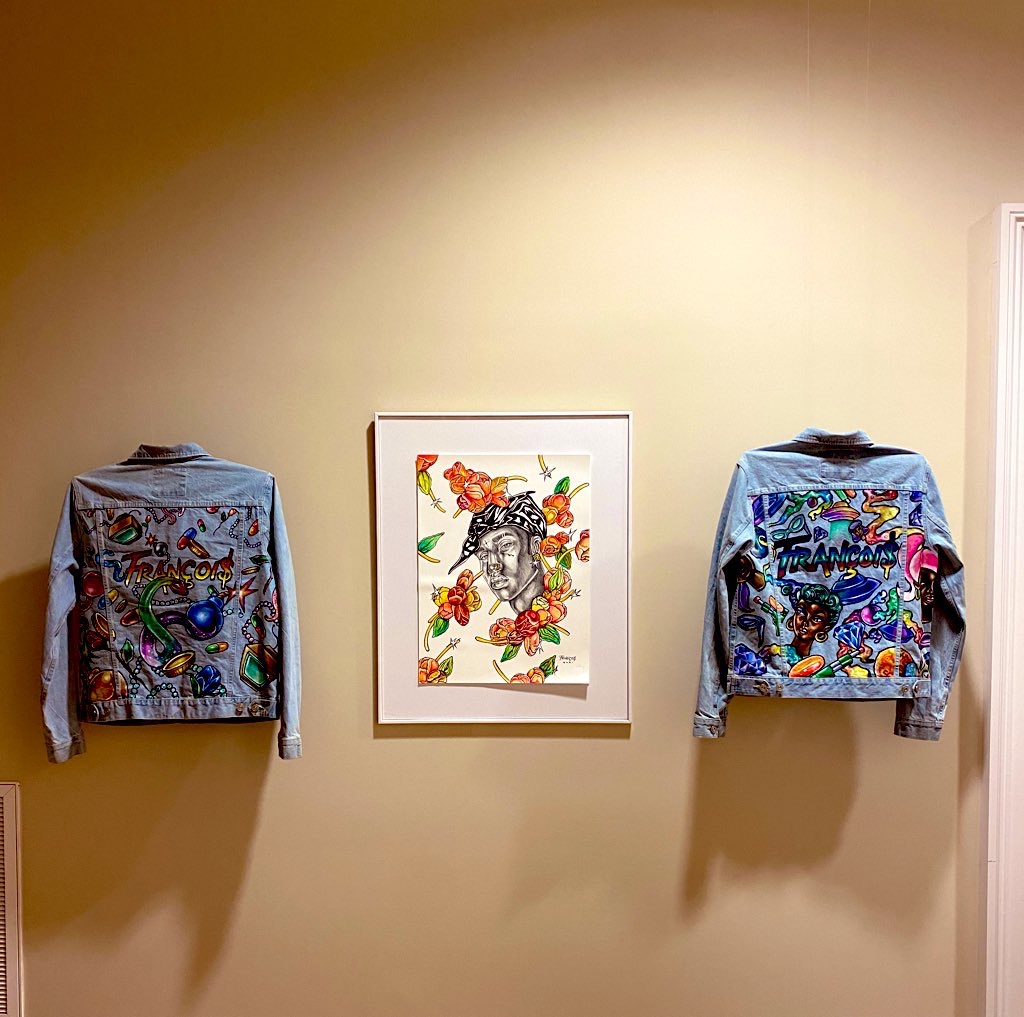
These works reflect the vibrancy of life and its complexities.
Stephen Montinar’s Hopscotch, Kriss Kross, Double Dutch the Gunshots acts as a bridge from the primordial waters into the earthly plane.
Jacq Francois’ Hot Boy Fantastic is an embodiment of the individual who carries the stories and lineages represented in the work. A kind of meeting of Civil’s masks with a contemporary diasporic lens. Francois is also of Haitian descent via New Orleans.
Nik Richard juxtaposes and correlates the regal and passionate power of both his grandmother as Carnival Queen and a recreation of the now iconographic photo portraits of Tupac Shakur.Along with Richard, Sly Watt’s unimpressed and Tatiana Kitchen’s Above and Below function as the departure point of the matrix. Reminding the viewer to consider the realms of earth, heaven and spirit present in the work and their own private and creative lives.
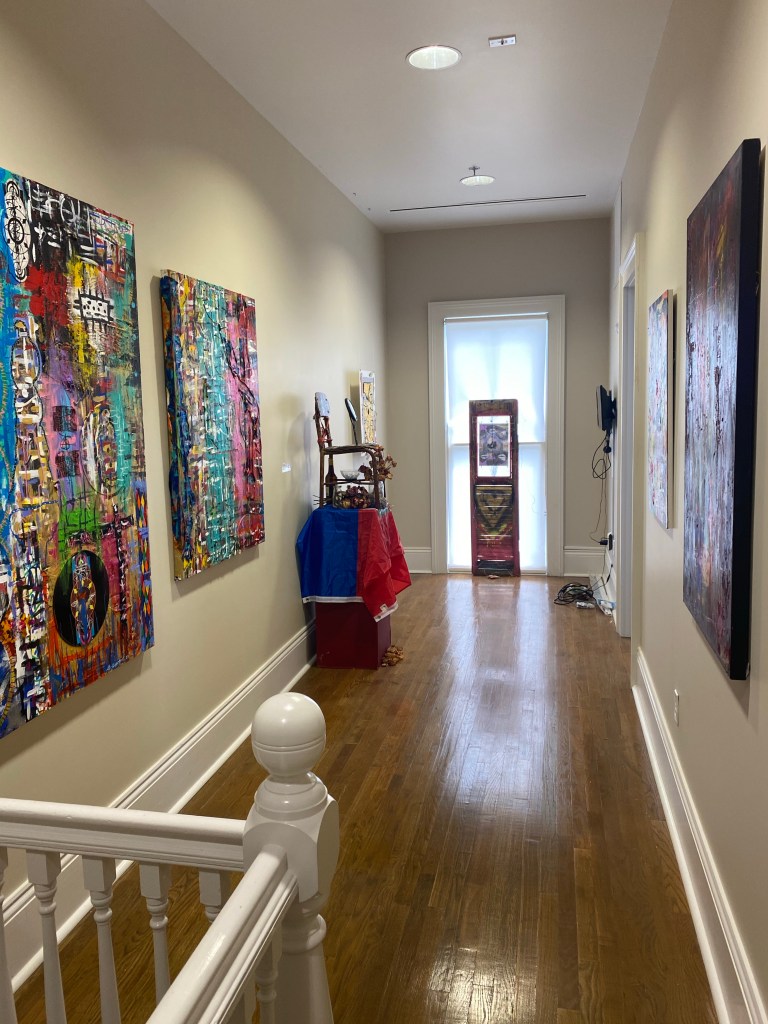
reflecting an organizing principle of Vodou , upstairs hallways have a “hot” and a “cool” side.
Upstairs
Altars
Ryann Sterling
Soraya Jean Louis
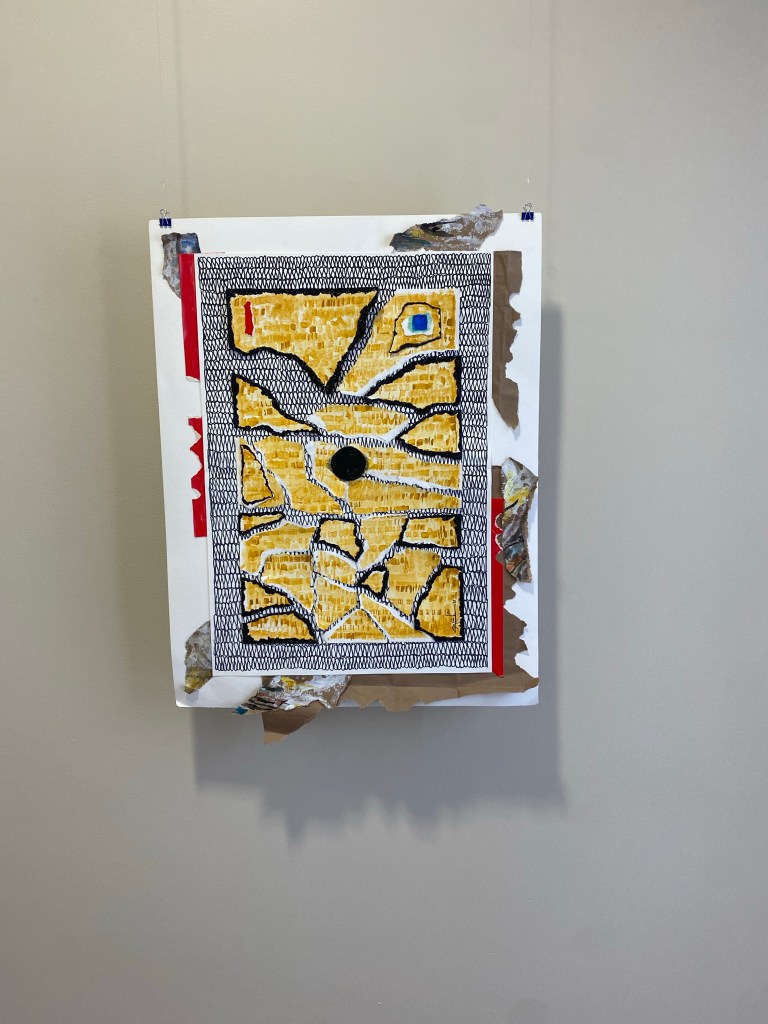

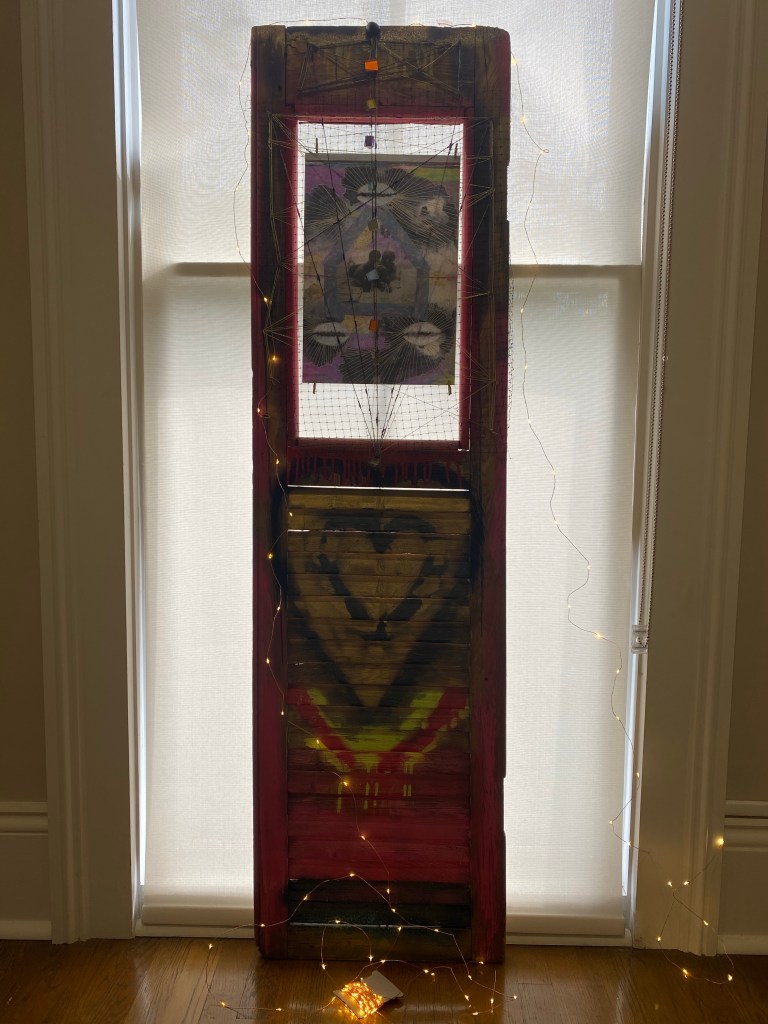
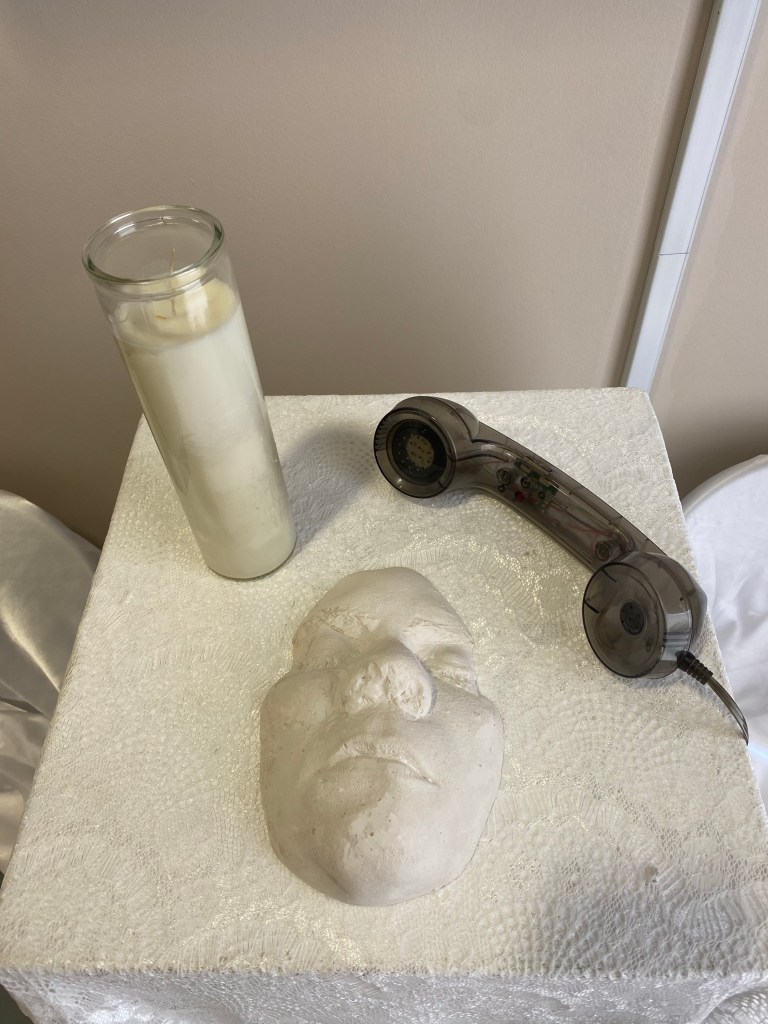

Ryann Sterling and SORAYA’s Jean Louis’ altars anchor this portion of the Matrx of Creativity. Serving as a place for and a reminder of sacred spaces’ function in the diaspora as places for worship and preservation of historical and spiritual lineage.
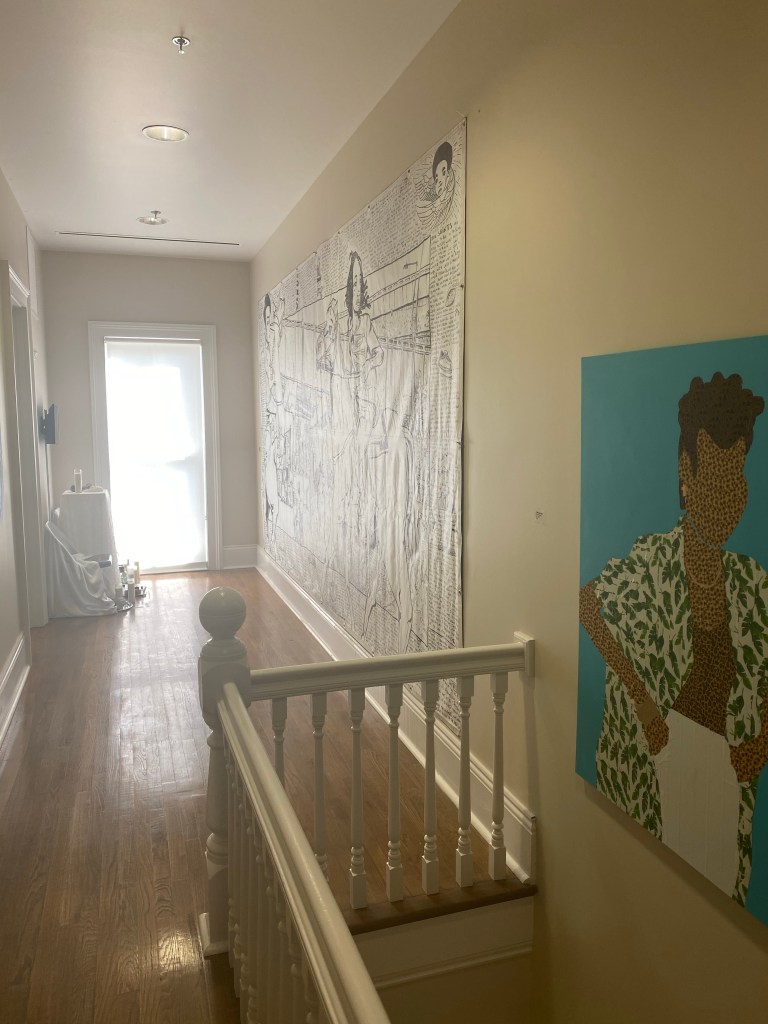
Langston Alston’s large-scale intricate work evokes the life and spirit of the city, animating and representing the physical embodiment of the work of the altars. Note the presence of archangels throughout his piece.
•Abstractions in Afrofuturism

Myesha Francis
Kennedi Andrus
Khalid Thompson
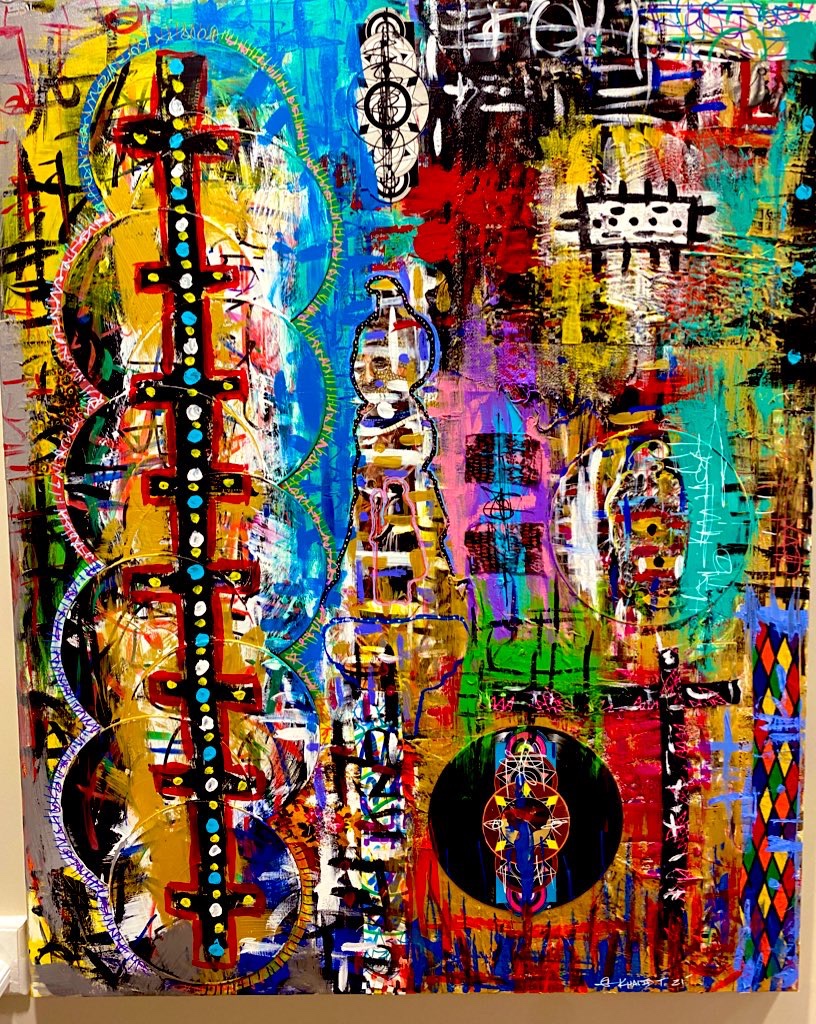
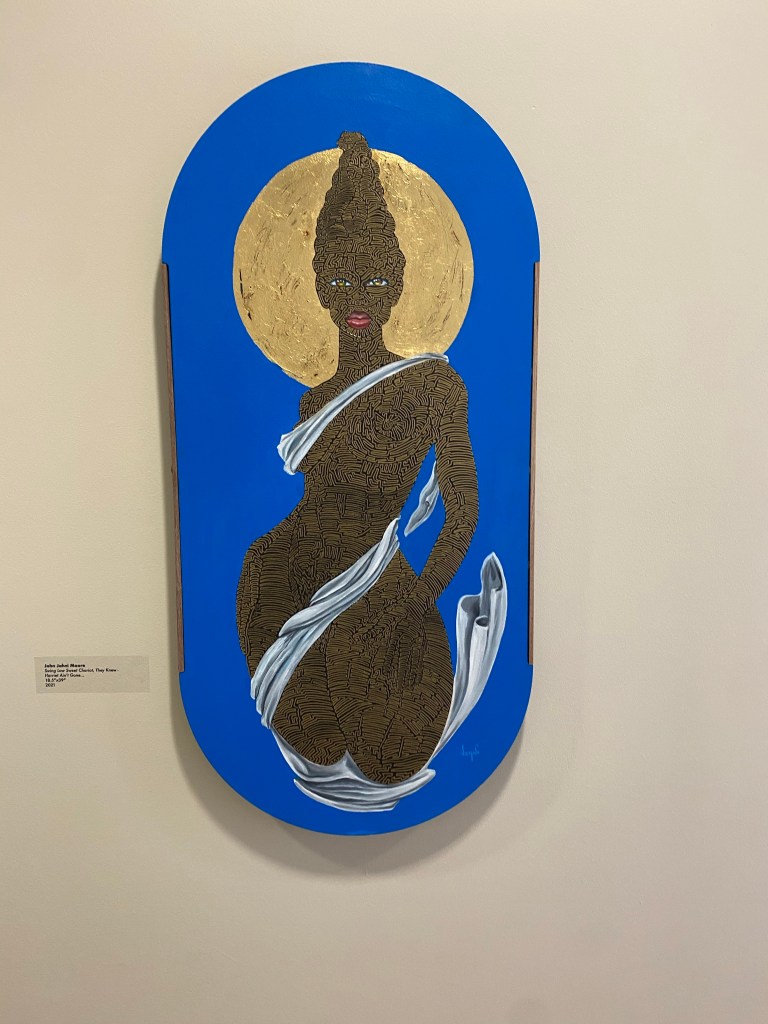
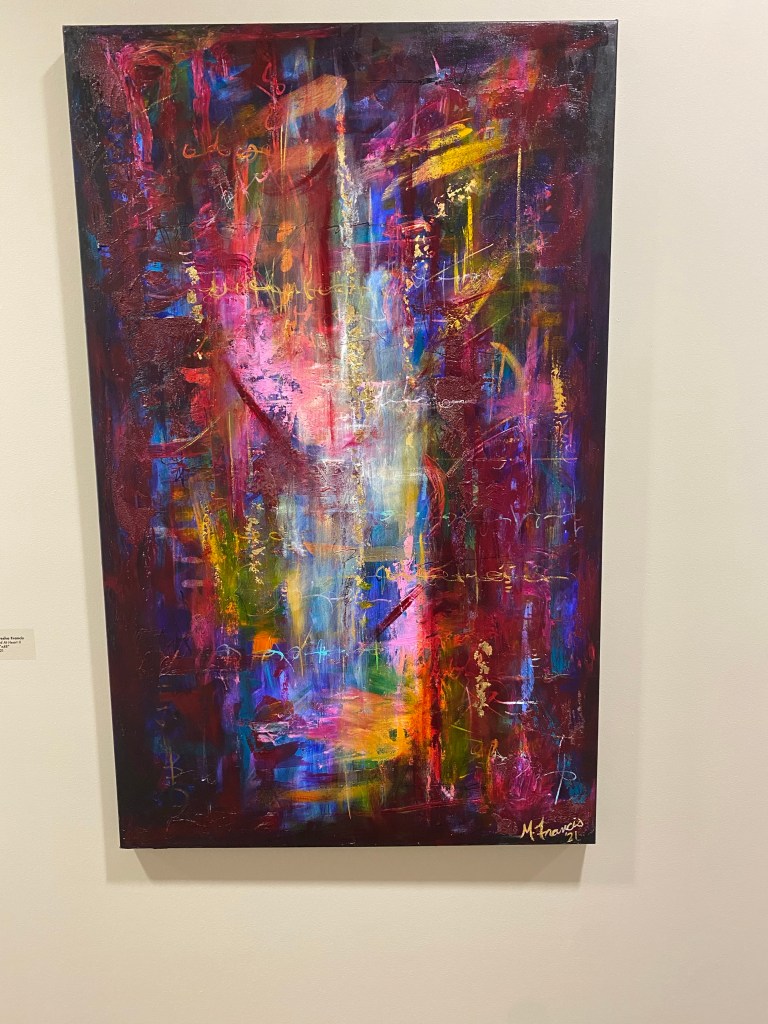
Opens up spaces for the mind to contemplate its contents in the context of Afrofuturism. Thompson’s Gold Coast Records embeds silent sonic presence for the viewer. Myesha Francis and Kennedi Andrus’ lush uses of color and brush stroke evoke the beauty of the heart as it’s own form of consciousness.
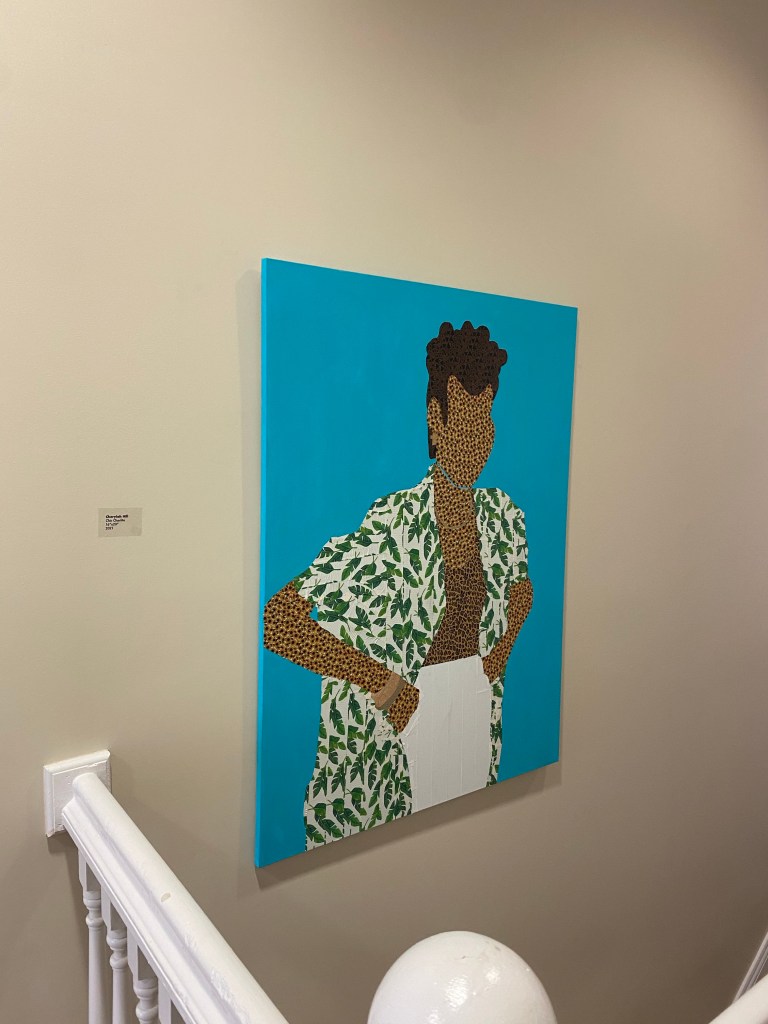
Cheriyah Hill, Rodrecas Davis, and Ashley Firstley use collaging and new media art to enliven the use of photo and canvas with an Afrofuturist lens.
•Resting Place of Saints.

Khalid Abdel Rahman
The tombs of Sufi Saints by Khalid Abdel Rahman calls the presence and spiritual principles of ancient architecture into the present.
Upstairs Room


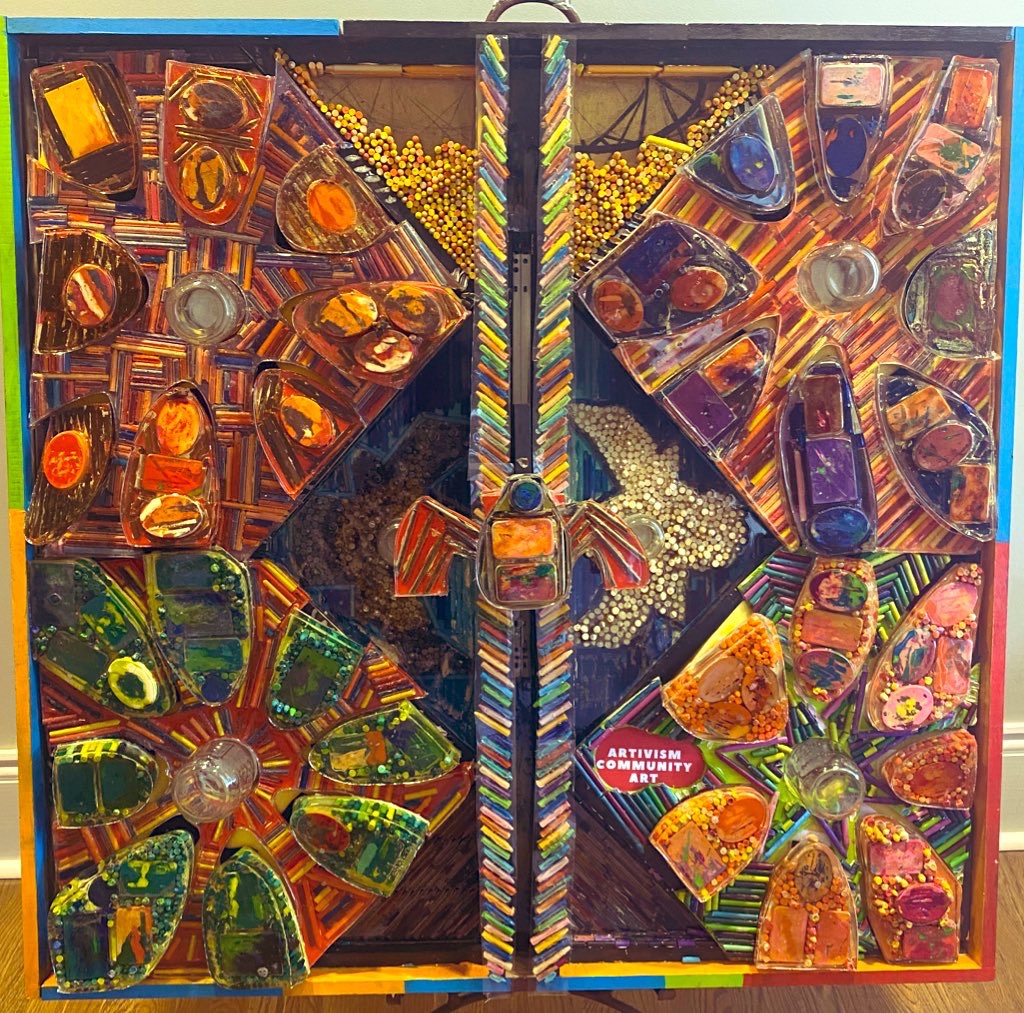


(Textile and Texture)
Cherice Harrison-Nelson is steeped in a West African rooted ceremonial dress art tradition, unique to African American communities in New Orleans. She is the third of five generations in her family to participate in the cultural legacy passed down from her late father, Big Chief Donald Harrison, Sr. She is the co-founder and curator of the Mardi Gras Indian Hall of Fame. Currently, the organization is working to protect intellectual property rights through the, “You Get Paid, I Get Paid” mutual respect and fair use campaign. Her original creations are held in the private collections of Jonathan Demme (Academy award-winning director – Silence of the Lambs), Wole Soyinka (first African Nobel Prize Laureate for literature) among others. Her aesthetic approach to her suits, in her words, represent an indigenous approach to minimalism in the masking tradition.
Schetuana Powell
Evokes the Ghanaian trickster deity, Anansi. In the Ghanian myth Anansi spins a golden thread to reach the heavens. There Anansi asks his father for the permission to bring the stories to humanity. In Sheppard’s iteration, Anansi, the figure, also holds the stories of many times, many families, many peoples. Anansi changes shape, changes stories, makes the necessary mischief to keep humanity innovative.
Eseosa Edibiri
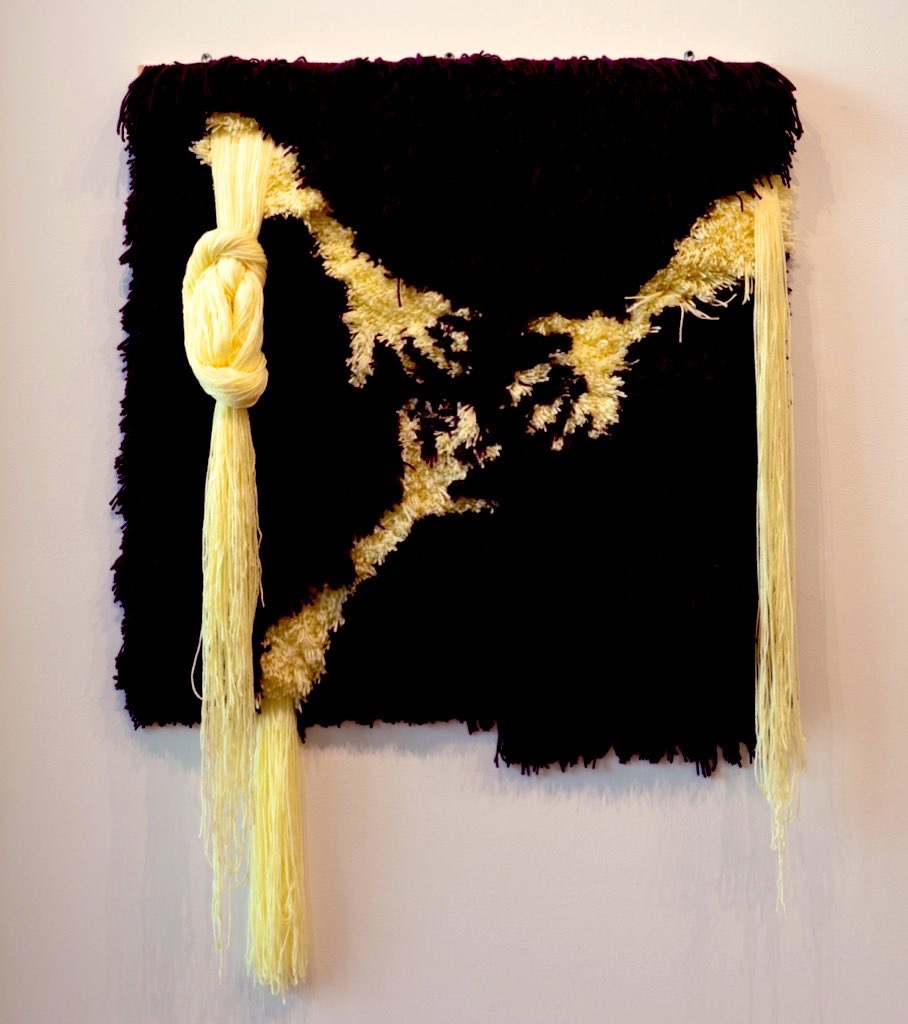
“My work addresses a serious need for the representation of black and brown bodies translated into text and imagery and then used within textile-based work, such as weavings, latch hook, prints, and tufted pieces. The text utilized within my work is taken from conversations between myself and those dear to me being their most true selves who may be caught mid-laugh or in a captured playful pose.”
Bianca Walker
Developing an MFA thesis at the University of New Orleans Walker uses these drips as an integral part of their visual language while incorporating archival imagery of the African Diaspora activating a history they can see being erased.
Lance Minto Strauss
Give Me Liberty…evokes the death of Malcolm X. We have this piece amongst the deities to reflect the ability of one human life to transcend mortal constraints.
Didier Civil
Didier Civil was born in 1973 in Jacmel, Haiti, a southern coastal town renowned for its carnival celebrations. He developed an interest in papier mâché at a very young age and learned about this art forme by studying Lyonel Simonis, a master artist and pioneer of papier mache mask making. Civil is a celebrated artist and mask maker in his own right. Civil makes fantastical to realistic paper mache masks and costumes, larger than life portraits and imaginative animals.


The beating was intense for a couple of seconds before the door came down and the police were everywhere. They took me out the bedroom, cuffed, and made me kneel down in the living room. Corey was in the kitchen. I could see him from where I knelt, his face pressed into the tile. The officers stood around him, one with his foot placed squarely in Corey’s back.
“Do you want to be pepper-sprayed or shot motherfucker?” the officer asked with his shoe in Corey’s back. “We just gonna have a look around. Before we take you out of here. Keep still or we see how tough you are with your brains on the carpet.”
“What was she doing in there?” the blonde, blue-eyed cop asked.
“What’s it look like?” replied the one standing over me. He smirked, scratched his curly head. “Waiting to get fucked.”
The cop shined his bright ass light on my face, on my chest, my legs, and thighs. The light was everywhere. My throat and chest burned but I was still. So was Corey. Be still. They can kill you. And if they do, they will get away with it. Be still. They took Corey out the door. I kept my head down; tears in my throat. I didn’t know why they were there. Be still. There were no lights or sirens in the pre-dawn shadow. Be still, Kalo. Be still, I said to myself.
“Alright Pocahontas. I need to see your ID,” the curly -head policeman said, flicking one of my two braids behind my shoulder. “Kaloneeka Bagneris,” the officer read my name aloud.
They didn’t ask me much beyond that and let me go. Lucky for me they did not realize I lived there. The blonde one offered me a ride, his light still on my ass. I declined.
When the sun came up, I caught the bus over to Habibti’s. The store had been a part of my morning for years before I moved in with Corey; wake-up, cross the street and get coffee and a biscuit before school. I always had a little crush on Fadi, whose uncle owned the store. But when Corey opened a tattoo shop on top of it, whatever mild flirtations had taken place between us were put to an end.
Corey and I had moved to be away from it all. Besides the tattoo shop on top of Habibti’s, he also co-owned a barbershop and a rim-shop. Corey was doing well, which meant if he wanted to stay both alive and free, he had to be low-key. The apartment we found was cut from a generous portion of an antebellum home, a block off St. Charles Avenue. The house’s massive construction made us feel like giants. Corey was rarely there during the day and it was right up the street from my university. We watched birds for hours from the balcony on the gallery side of the apartment. Just the day before the police arrived, a red bird, a yellow bird and a blue bird lined up on a branch. Corey said it was unusual, almost unbelievable, that they got so close to each other.
Fadi was standing outside smoking a cigarette when I approached. His curly black hair was wild around his head like a halo; his beard so shiny it glittered. He was gorgeous in the sunlight.
“What’s up, Kalo?” Fadi said in his heavy voice.
“The entire world, I don’t know. Fadi, what the fuck? You know what happened last night?”
“Course, Kalo. Me and the entire city, baby, when they wake up. Look at this shit.” Fadi pointed to the copy of The Times Picayune, resting on top a vending machine full of the papers.
Corey and Xavier’s pictures were plastered across the front page. “The Two Most Dangerous Men in New Orleans” the headline read. My breath was gone. Fadi tossed his cigarette on the ground.
“They got Corey as the shooter, Kalo. Seventeen-shots. They say Xavier was driving.”
I picked up the paper again. There were several other articles on the front page discussing other aspects of the case besides the headline article I had read at Habibti’s. They were digging up all of Xavier and Corey’s family history. The reporter on television spoke of the long-standing ties between the St. Martins and the Jamesons. There was also a story on the local news about Cheryl Jameson, one of Corey’s second or third cousins. She was going on trial for some kind of fraud.
“What do they mean, how did Cheryl post her bond?” I asked Fadi. “She has a job.”
“You know how they do, Kalo. They try to connect all the dots. And the ones they can’t they make it up.”
“I think I’m going to be sick, Fadi. I don’t have anywhere to go. I can’t go back to that apartment. ”
“Don’t trip, you know you can stay with me. But, brace yourself, Kalo. You ain’t seen nothing yet.”
Sigrid said she was five minutes away, but that was three cigarettes ago. I didn’t have anything to wear, and so every extra minute of waiting to get the night started was killing me. I pushed my feet into tan cowboy boots and fought the jabbing in my stomach that made me want to cry. Maybe Sigrid was having the same problem. Most of her clothes were in New York— mine underwater. Outside on the porch, I waited. Stared down at the houses located lower in the hills than my father’s apartment. The distinct feeling of being perched rather than tucked down deep made me shiver.
Georgia was cold in the winter. Cold and no water.
I hadn’t ashed the butt or put it out, before I had another cigarette lit. I liked to blame Roxie for my almost pack a day habit. One after another, I had sucked them back out in front of Motel 6 in Houston. Watching more and more people, show up and leave, show-up and leave. Roxie had all the info. Who was giving away what where. Which places had short lines; where if you went, you would punch some white person’s teeth out, so don’t go.
“Girl, this is some fucked up shit, right?” Roxie said one afternoon in Houston. “It’s just starting to sink in that we’re not going back home. Least no time soon.” Roxie shook her head. “Girl, these evil motherfuckers. Those bitches were trying to send my sister and them way to motherfucking Utah. You know we cut up. Then they threaten to put cuffs on me. Like the nerve of us not to want to go separate from one another. How the fuck that go?”
Roxie reached in her bag and gave me two cartons of Kools. I asked her what she wanted in return. The night before that, I had traded packs of socks for cans of green beans and box jambalaya. Before that I traded a dude down the hall from me laundry detergent, razors, coconut oil, and shampoo for some of the tennis shoes he was selling. She left the motel after a week with a voucher from a church and headed to an apartment complex. She wasn’t wasting no time. Roxie knew it all. Corey died in Texas before the month was out. I wondered if she knew that.Roxie didn’t want anything back from me. She said her son had a whole trunk full of cigarettes. Take them. One less thing to worry about for a while.
Welcome to the AfroFuture:
The Matrix of Creativity: Where the River Meets the Sea
curatorial statement
In a 1986 interview with Dr. Jerry Ward Jr. , New Orleans writer and griot, Tom Dent, Ward characterizes New Orleans as a “matrix for creativity.” The fugitive praxis of syncretism ( the combination of different religions or religious traditions into a new form) manifests throughout the continuum of this land’s history from the pre-colonial Mobilian trading language created by the numerous nations indigenous to this estuary, the Kouri Vini (Louisiana Creole) spoken by the descendants of enslaved Africans and Natives, to the spiritual invention of New Orleans gris gris and in the sound of brass, jazz, and bounce music.
The cosmology of the Bambara, a Mandé people, who made up a larger portion of the enslaved population in Louisiana than anywhere else in the Western Hemisphere, is described in some detail in Gwendolyn Midlo Hall’s Africans in Colonial Louisiana. “According to this cosmology, the universe, emerging from a moving void, undergoes a slow process of acquiring voice and vibration that eventually evolves into light, sound, creatures, actions, and human sentiments. The order of this universe is expressed arithmetically through numbers one through seven, as is outlined in Cheikh Anta Diop’s, Civilization or Barbarism. Native to Mali and later stolen from the Senegambia region, the Bambara’s cosmology is designed to be transported across distance.
In Flash of the Spirit, Robert Farris Thompson examines the word Mandekan word woron. Meaning to “get the kernel,” it encapsulates the process needed to master speech, song, music, or any aesthetic endeavor. Thompson goes on to outline the Mandé concept of reason, which relies on a balance of opposites, badenya (the conformist) and fadenya (the innovator).
It is this tension between tradition and innovation that produces a culture always in flux, always moving, changing, and reinventing the world. For example: the five hundred Black rebels in 1811 of various ethnicity, who envisioned a free New Orleans, a free Louisiana, and an America free from slavery or the Natchez and Bambara nations, who just ten years after the Louisiana colony’s establishment, conspired together to overturn it. It is both the retention of key African cultural concepts and the space and ability to innovate in New Orleans that makes the city the perpetual site of what’s new and next on the horizon.
As such, The Matrix of Creativity : Where the River Meets the Sea holds space for both traditional and new interpretations of who and what constitutes the work, history, and legacy of Afrofuturism.
SHOW NOTES
Front Hall
(downstairs )
Sokari Ekine
Jameel Paulin
Dianne Baquet
•EKINE’s archives of fire and water mark a spiritual and aesthetic point of origin as well as Paulin’s African Fractals.
• Feliciane and Child, Refugee from San Domingue by Dianne Baquet grounds these ideas in the historical by evoking the arrival of Haitians to New Orleans during and following the revolution.
Back Hall
“the bright earth”
These works reflect the vibrancy of life and its complexities.
Stephen Montinar’s Hopscotch, Kriss Kross, Double Dutch the Gunshots acts as a bridge from the primordial waters into the earthly plane.
Jacq Francois’ Hot Boy Fantastic is an embodiment of the individual who carries the stories and lineages represented in the work. A kind of meeting of Civil’s masks with a contemporary diasporic lens. Francois is also of Haitian descent via New Orleans.
Nik Richard juxtaposes and correlates the regal and passionate power of both his grandmother as Carnival Queen and a recreation of the now iconographic photo portraits of Tupac Shakur.Along with Richard, Sly Watt’s unimpressed and Tatiana Kitchen’s Above and Below function as the departure point of the matrix. Reminding the viewer to consider the realms of earth, heaven and spirit present in the work and their own private and creative lives.
reflecting an organizing principle of Vodou , upstairs hallways have a “hot” and a “cool” side.
Upstairs
Altars
Ryann Sterling
Soraya Jean Louis
Ryann Sterling and SORAYA’s Jean Louis’ altars anchor this portion of the Matrx of Creativity. Serving as a place for and a reminder of sacred spaces’ function in the diaspora as places for worship and preservation of historical and spiritual lineage.
Langston Alston’s large-scale intricate work evokes the life and spirit of the city, animating and representing the physical embodiment of the work of the altars. Note the presence of archangels throughout his piece.
•Abstractions in Afrofuturism
Myesha Francis
Kennedi Andrus
Khalid Thompson
Opens up spaces for the mind to contemplate its contents in the context of Afrofuturism. Thompson’s Gold Coast Records embeds silent sonic presence for the viewer. Myesha Francis and Kennedi Andrus’ lush uses of color and brush stroke evoke the beauty of the heart as it’s own form of consciousness.
Cheriyah Hill, Rodrecas Davis, and Ashley Firstley use collaging and new media art to enliven the use of photo and canvas with an Afrofuturist lens.
•Resting Place of Saints.
Khalid Abdel Rahman
The tombs of Sufi Saints by Khalid Abdel Rahman calls the presence and spiritual principles of ancient architecture into the present.
Upstairs Room
(Textile and Texture)
Cherice Harrison-Nelson is steeped in a West African rooted ceremonial dress art tradition, unique to African American communities in New Orleans. She is the third of five generations in her family to participate in the cultural legacy passed down from her late father, Big Chief Donald Harrison, Sr. She is the co-founder and curator of the Mardi Gras Indian Hall of Fame. Currently, the organization is working to protect intellectual property rights through the, “You Get Paid, I Get Paid” mutual respect and fair use campaign. Her original creations are held in the private collections of Jonathan Demme (Academy award-winning director – Silence of the Lambs), Wole Soyinka (first African Nobel Prize Laureate for literature) among others. Her aesthetic approach to her suits, in her words, represent an indigenous approach to minimalism in the masking tradition.
Schetuana Powell
Evokes the Ghanaian trickster deity, Anansi. In the Ghanian myth Anansi spins a golden thread to reach the heavens. There Anansi asks his father for the permission to bring the stories to humanity. In Sheppard’s iteration, Anansi, the figure, also holds the stories of many times, many families, many peoples. Anansi changes shape, changes stories, makes the necessary mischief to keep humanity innovative.
Eseosa Edibiri
“My work addresses a serious need for the representation of black and brown bodies translated into text and imagery and then used within textile-based work, such as weavings, latch hook, prints, and tufted pieces. The text utilized within my work is taken from conversations between myself and those dear to me being their most true selves who may be caught mid-laugh or in a captured playful pose.”
Bianca Walker
Developing an MFA thesis at the University of New Orleans Walker uses these drips as an integral part of their visual language while incorporating archival imagery of the African Diaspora activating a history they can see being erased.
Lance Minto Strauss
Give Me Liberty…evokes the death of Malcolm X. We have this piece amongst the deities to reflect the ability of one human life to transcend mortal constraints.
Didier Civil
Didier Civil was born in 1973 in Jacmel, Haiti, a southern coastal town renowned for its carnival celebrations. He developed an interest in papier mâché at a very young age and learned about this art forme by studying Lyonel Simonis, a master artist and pioneer of papier mache mask making. Civil is a celebrated artist and mask maker in his own right. Civil makes fantastical to realistic paper mache masks and costumes, larger than life portraits and imaginative animals.

#shakeitfoyohood
There was a loud bang and then something that rattled the panes. Iema Kola looked out the window. She wondered if any of the others in the house heard what she had. A little bit like thunder but not quite. It was a different kind of vibration. A humming. A buzzing. More than a rumble. Iema Kola made a move to check her phone then she remembered it was no use. The house had no reception of any kind. It had been a couple days since things had gone black. They were in a black zone. No internet, no data. Iema Kola fell back on to her sea of pillows and sighed.
Future accounts of the POTUS’s speech would be heavily redacted, but nonetheless, it had given it the previous evening. The speech was to explain why the free use of the internet and social media had been suspended or heavily restricted in certain areas of the country.
Temporarily, she said.
While those outside the black zones, those with the proper photo identification, paid fee, and background check sent as a PDF file could apply through a special online portal to have their partial web-surfing, and email access restored—social media in the deemed black zones would remain as such. Black.
While she regretted that honest, hard-working Americans need suffer for the actions of a willful few, what those of her own party, the small government purists, needed to understand was that national security dictated this action.
Patriotism would require the suspension of some principles. We had been here before. Iraq, Iran, Beirut, Atlanta, 9-11, and now this. What had seemed like harmless group ranting had materialized into a serious domestic threat. The primary means of communication, the POTUS went on, for this group had been online.
A (nearly) successful attempt to co-opt the strategies (use of social media to organize) of the Arab Spring, and other movements for democracy, by this domestic insurgency was in the process of being thwarted. This would all be over soon. Very soon. She asked for the trust and support and faith of the American people. She would not let them down, nor would she ever betray their trust. That’s what she said.
Iema Kola felt the house rock again, this time she knew it wasn’t thunder. Her eyes watered, shoulders shook, and things went silent.
#comeserveme
They started laying down the bike paths with the city and dead bodies still stinking in the rotting houses. Iema Kola knew then it would all come down to the come down. Just how it would go down was always the question. One night, she had a dream. People were fighting; it was hand to hand, muskets, and AR-15’s. There was a bugle boy playing and all that. Iema Kola couldn’t tell who was who, or where she belonged in the battle, no one could. It was just people shooting and cutting whoever they could get their hands on.
Iema Kola woke up from that dream to people were moving into the house next door. More and more of them were coming every day.
Having lost it all in the water, it was strange to frequent old places with new names. Old places that Iema Kola longed for, but sometimes could barely remember. All Iema Kola really knew for sure was that the more and more of them that came, the less she could figure who she was anymore.
Her neighborhood was filled with ghosts.
Sometimes Iema Kola wondered if she was dead. She said that to her brother, Papo once, asked if he ever felt dead. Papo said, fuck no. Shut up, and talk better to yourself. Iema Kola could not tell if this conversation happened in the past or the present or some tense just beyond what she could articulate. It had all begun to make her back ache.
Iema Kola had seen a lot bought and sold. Helped out in her own way. One love, the best love she had known was buried. Iema Kola clung to Papo now because he was all the family she had left. Their friend Fadi clung to them. He also, like Iema Kola and Papo, had nowhere to go. He would not abandon them. Fadi had lost one house to the water and the other to a wave of high-rises on hills in Felasteen. Settlers looking over the bluff at the trees, deciding how many must go. Home had become an abstraction amongst the refurbished shotgun doubles and a settlement far away overlooking an orchard waiting to burn.
Iema Kola was still grateful— even as the casket closed, to have seen what she had. With her love. She shed tears for what she and Corey had done wrong; together and apart. Iema Kola let it gnaw on her heart, the tiny balled up foil paper, she had found in his pocket coated with something that coulda been something else that she threw out.
What did heroin look like when you lit a flame under it? Certain things he had kept from her. Iema Kola did not try to see if it would bubble up.
#yallholla
The shit popped off after the police shot Iema Kola’s cousin, Tipoo, a musician, dead. This is how it started, Papo told her. Papo said the fight started because the fiddlers said Tipoo and them were playing on their corner. Tipoo said aint no way it was their fucking corner and they weren’t leaving. Either way some pushing started and one of the fiddlers called the people. When the police showed up, they made Tipoo and them lie down on the ground. Then the police say Tipoo reached in his waistband for a gun that was never found. The police opened fire and then Tipoo was dead, shot up, arms, legs, neck and back and head. Just like that. People in the neighborhood had caught that shit on all kinds of phones and cameras. Soon the stills and videos of Tipoo’s body bucking from the onslaught were spreading like a virus. Or a fire.
#urielswar
Every day there were videos and all that shit. It was happening everywhere. And all the time it was online and people were talking about all the shit they saw. People shot or hit with cars, lying on the ground with their heads split. Everyday a boy or a man you knew. Women too. The police were ubiquitous in their milling. The veil lifted. Bullets flew in all directions. There was nothing to shield yourself from the lens of whatever camera was shooting them.
So, they didn’t have to see it coming. It just happened and they were ready. Fadi had lost his own country before he was even born. So much had left his palms bloody from trying to hold on. A wise man would let go. But this city and Iema Kola— he loved.
#cosimfree
At first Iema Kola and Papo just fucked shit up. Good and hard. They poured blood on ______, and _______, and the ________, and lots of other places, where people had been bought and sold. Iema Kola was too sad to be angry, or be scared, or even really care about what she was doing. Sometimes you had just had enough. That’s when you lost all fear. The only place to go from there was forward. They found the house of the fiddler, who had called the cops in the first place, and lit it ablaze.
#ifoundyoulostandwandering
Iema Kola knew Ferd from wandering. All day, Iema Kola wandered around the city. Popping her head in and out of stores, resting for a while in coffee shops. Place to place, trying to find something familiar in the city where she had grown up. It was something for a storm just to come in and wipe your slate clean. Ferd was one of the new things. He lived out in some group of trailers, with some white people, who all shared some connecting electricity and water, or some shit he tried to explain.
Iema Kola had tried to tell him before that the white people here weren’t like the ones he knew in Seattle. And that the ones from Seattle would be different because they were here. Why do you think they came down South? Ferd always laughed uncomfortably.
Now today, as Iema Kola sipped mint tea amongst them trying to act natural, she could tell Ferd needed to talk. Someone to tell. They stepped outside the coffee shop for a cigarette, and Ferd whispered. Since the fires, and the statues, he looked in her eyes; they had cut his water and electricity. They were trying to act like it was just some malfunction; his buddy was working on it. But it was only his trailer out of ten. Only his trailer, he repeated. Plus he had heard the snips.
They want me to have to ask for everything, Ferd said.
So they can keep you, answered Iema Kola.
#youaremylegacy
Iema Kola remembered a day when she was a little girl. She had left the gas stove running in her house. She remembered her daddy screaming so loud it made her tremble. He pushed her over to the stove and made her turn it off. He held her hair and head at the base of her neck and pressed her face near the burner, so close she could feel the lingering warmth on her face. Now, that’s off, he said. Iema Kola remembered looking up at her father’s eyes. They were crazed. He was a man she did not know.
She would not know him really again until he after the water had washed the house’s contents clean. Her Daddy told her standing inside its shell of wooden angles, that when he was ten, the same year Wharlest’s Jackson’s car exploded, that he had drug himself out of his house in Mississippi. A house filled with gas— ready to blow.
#runningupthathill
Ferd asked if he could come with her. Papo would be mad. Anybody foolish enough to have been living the way he had could not be trusted. She knew that’s what he would say. But Ferd was so scared, and small, and hungry, she couldn’t just leave him. Papo relented and said he could stay the night. Iema Kola and Papo’s childhood friend, Tara and her girl, Koi were at the house too, in from across the world. Doogie, Papo’s friend, over to smoke something with them. For the night, they feel elated. Like a family again. It had been so long since they had familiar people to love.
Three white drifters died in the fire and a policeman. Iema had seen the news report the night before. She recognized one of the dead, a white girl, who had cashed in her ones from violin playing, at one of the coffee shops she frequented. Iema Kola’s eyes burned. She wondered through her grief where the news report about Tipoo, and every other dead kid she had known had been? That was a feeling that turned her stomach. Soft music played while the montage of the victims flashed across the screen.
a tune that almost sounded like the Jaws theme song blared signaling breaking news, It was Iema Kola’s face on TV. She, Tara, Fadi, Doogie, and Koi’s faces. No Ferd. Iema Kola stared at her face as though it were not her own. These were the gleeful faces of murder and mayhem, the reporter said. 2 Black males, an Arab, 1 black woman, and one woman believed to be of Indigenous descent, the report said.
In the haze of the pre-dawn morning men are outside Iema Kola and Papo’s door. Then they are inside, guns drawn. Papo, always quick as light, lets the shots go off with precision and before Iema Kola is even able to comprehend what is happening. Papo ‘s eyes are aflame with all that has happened. Iema Kola and Tara and Ferd, Doogie, Fadi and Koi have nothing to do but follow him out the back door into the dawn. The dead men’s lives, whoever they were, were worth several generations of hers.This is one thing, storm or no storm, that hasn’t changed. This Iema Kola knows for sure.
#electronicintifada
What none of them knew was that now that they were running was that the pictures, and the videos, and the gifs of the statues, and bicycles, and houses, and fiddles burning, all the things they had burned went viral all over the country and the world. People in their own city were in the street, calling for justice for Tipoo. And they had everywhere from Harlem to Detroit, Chicago, Brooklyn and even Memphissippi shaking. More fires were lit at home. They said the source was a group in New Orleans, the same ones responsible for the death of three in camouflage. They made it seem like Iema Kola and them were a cell of sorts. There were rallies. Peaceful ones, of the black, and the brown, and the red, and the yellow, and the white people that said they loved, them pleading for calm and for reason. Iema Kola’s face was on TV. She, Tara, Koi, Doogie, Fadi and Papo. Not Ferd. These were the faces of gleeful murder and mayhem, the reporter said, it had become almost a refrain.
#expressyourself
In 1985, Ferd lost his mother and father in a bombing in LA. Ferd had been sitting in his mother’s lap. Still a baby, he had just begun to speak. The batteram hit the door. Frightened, his father shot and they shot back. They dropped something on the house from a helicopter, killing Ferd’s mother for good measure. Ferd’s survival had to be studied. He was taken into the custody of the state, where he had remained until asking Iema Kola for shelter.
Iema Kola’s dad told her the morning they blew up Wharlest’s car, he had heartburn. He was only ten and he knew something was wrong. Iema Kola knew something was now watching. Something whose sight they couldn’t escape. Iema Kola felt marked, she had risen with the fiery feeling in her ribcage. She told this to Fadi in his ear while he pretended to sleep. Fadi turned to face her and said he knew. Fadi said his dad had been killed while riding in a car in Gaza City about a decade ago.
How? Iema Kola asked.
Fire, Fadi said. How else? It just fell out of the sky.
#republica
The old people that were housing them and helping them on their way out to the free territory had a spare, but nice bathroom. White claw foot tub and old fashioned basin. There were candles and small altars to the martyrs in the various corners. Iema Kola prepared. Turns out, Ferd’s stupid ass told some white girl, who “wasn’t like that” that he had had somewhere to sleep for the night. She had been the one to call the cops. Ferd was out by the river praying when he went missing. He swore. Please don’t tell Papo, he begged.
Ninety-nine miles the border, Papo had gotten them there quick. He knew every land route out of America that existed. Iema Kola decided she would ask Ferd to his face if he had betrayed them. His face had yet to appear on the news. Iema Kola ran around the safehouse trying to find him but we was gone. Iema Kola doubled over, not sure of what was coming next.
Iema Kola thought about when that barge or that bomb that hit the levee. The blast and the fast moving water sounded like a locomotive. Outside the small cloudy glass window, she heard Ferd scream and then a bang and then only silence.
Knees buckling, Iema Kola added a splash of Florida water to the rosewater already in the basin and dipped her hands in it. She washed her hands wrist to elbow, scrubbed her face, mouth, and throat, and ran her wet fingers through her hair. She let a little dribble in her ears and then bent down to work on her feet. A little in the mouth. Spit with purpose. Iema Kola rose from her knees and heard the buzzing. Buzzing. The buzzing of a million bees that’s what it sounded like, hovering closer and closer.
Ninety-nine miles to the border, Iema Kola got down again on her knees. Palms turned upward, she began to pray. Certain, whatever had been stalking the sky above them had found its prey.
—Kristina Kay Robinson, 8/18/14.
that’s quite a lot of silences held
for one who has already said too much
we
on either side of the glass
cannot avoid each other
this story will take an eternity
the price
your curse—
try
Black Virgin
.
.
.
“Please man. Just this time… take care of me, Co?”
“Come on,” I said, and lead the man whose voice had broken the dark and the woman he had with him to the back of the store.
The woman was young and quiet, too fucking quiet. She was wearing a pair of men’s jean shorts and a sports bra. Not fat, but her middle was loose and fleshy. She had this wide-eyed look of perpetual surprise. I gave them what they needed and tried not to look her in the face.
Back in front the store this girl was talking on a battered cell phone. Arguing with someone about shoe insoles and washing powder. She was a real pretty girl, with hair that looked like if she uncoiled it from the nape of her neck, would probably reach her butt. Once she walked inside the store, she hung up on whoever she was talking to. I watched the way the black and white stripes of her leggings moved across her legs, as she walked around the store all lazy-like, picking shit up, looking at it a long time, then putting it down. She’s stared at two boxes of Jiffy cornbread mix, like it made a difference.
I went inside to holler at Fadi for a second. Maybe get a little closer to her too. “I’m done. You know her?” I asked and motioned in the girl’s direction.
“Who? Panda? Yeah. She works across the street at the club. You never seen her in there?”
I glanced in her direction. Her eyes were red. I figured she had been smoking, but she could have been crying or both.
“How much?” she asked Fadi, holding up a toilet scrubber.
Fadi made a motion that suggested she look at the sticker. “It’s not marked, must be free.”
She walked up to the counter with a basket full of things. Toothbrush, ten boxes of cornbread mix, toilet-scrubber, detergent, a pack of sponge rollers, Lysol, and hand sanitizer.
“How’s it going over there?” Fadi nodded his head in the direction of the club across the street.
“You work over at Bottoms?” I asked. “How come I never seen you in there?”
“I’m only there a couple nights. But I know him,” she flung her hand in Fadi’s direction and laughed. “But I don’t know you. What’s your name?”
“Corey.”
“Well Corey…how about this… even if he stays home, you come see me, tonight, ok?”
“No, but I think you’re cute,” Panda reached out and gave a few of my dreads a light tug.
I should have said something back. Anything. Squeezed the side of her waist. She would have liked that. Instead, I just stood there.
Panda stared at me like she was reading my mind. My eyes followed her out the door.
“I not going to lie, man,” I said, as I watched her stripes move through the glass. “I like lil’ one’s style.”
“Slow your roll, Co. You know that girl Peanutt? That’s her sister. They’re trouble.” Fadi laughed, but I could tell he meant it.
“That’s exactly what I’m looking for, dog” I answered.
I meant that too.
The power was out. My Paw was out of town and forgot to pay the light bill. I had the money to turn the lights back on but fuck it. I was about to cop an apartment and some real work of my own. I could sleep without lights for a couple days. I lit all the candles I kept on my drawing table. I needed to clean myself. I smelled like outside. Like a puppy dog, my mama would have said if she could smell me. The hot water from the bathroom steamed up my entire room. The tiny bathroom connected to my bedroom reminded me of a cell. Once in the shower, the sweat started to pour. I had to sit down to keep from passing out.
The water rushed over my head and Peanutt popped up in my mind when I closed my eyes. She worked at Bottoms from time to time and always needed two things when she saw me. That shit to get her up, before work, and that shit to get her back down, once she was home. I didn’t know she had a sister. But I was gonna pretend like I still didn’t. I had messed around with her a few times before I realized how bad off, she was. Then there was Kalo. My baby girl. All I could do was lie to her about it all.
Damn near two in the morning, and still too hot to sleep. My Pa was trying to wait me out, make me pay the bill, probably, but whatever. He had been doing this shit since I was ten years old. Leaving and returning with little warning. I called Fadi to see if he was done at Habibti’s and felt like dipping through Bottoms. I was really trying to see that girl. When he pulled up, I was happier for the air conditioner than the blunt he passed to me.
“Xavier back from Miami yet?”
“Yep,” Fadi said. “I talked to him earlier. He said tomorrow and we’ll be all good.”
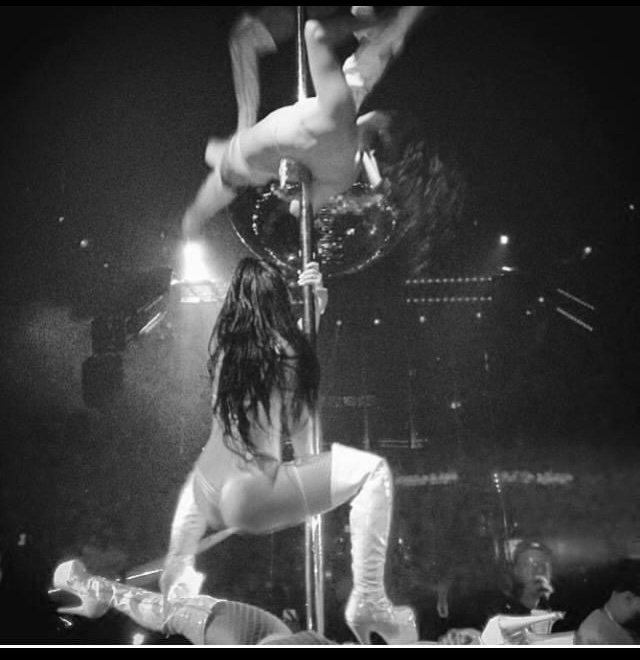
Inside Bottoms, we saw each other at the same time. Panda was leaning up against the bar talking into the side of this man’s neck. She stood in place, but moved all the loose flesh on her body, which was just enough for a good show. The man slid money in the little bag she wore around her waist. She looked past him, straight at me. Her hair was all hanging down looking like falling water. Her snow-white top and bottom were slashed all over the place, nipples poked out the holes in her top. I was impressed by how much like a bride she looked. I wished I had flowers for her. I wasn’t really hung up on the good girl shit.
When the song ended, Panda patted the guy’s shoulders, gave him a kiss on the cheek, and headed in my direction.
Fadi was already looking uncomfortable. I knew he was going to leave once he was done taking care of business. I could find my own way home, and if not, Fadi would come back for me. That’s why we were friends. When Panda made it over, I reached out to put my hand around her waist and pull her toward me a little. Not too hard, but just affectionately, to show her I wanted her.
“I think I’m good for the night,” Panda said.
“Oh yeah?” I answered. “Lucky you.”
“Yeah, let’s go. But I don’t have a ride right now. You?”
Out of her money bag she pulled out this black spool of cloth. When she unrolled it, turned out it was a real thin black dress that reached almost to the floor. I watched as she pulled it over her head. It fell soft and wavy, where it should, on her body and we walked out the club together.
“My place?” she asked.
I nodded.
“You talk real cute, you know that? Where you from?” I asked her, as we got into the backseat.
“Here, but I left when I was like fourteen. I just came back to New Orleans like 6 months ago.”
“Where you coming back from?”
“Barbados,” she answered.
Usually, when I was with a girl, I didn’t ask many questions. This time I did and it brought something into the small space of the back of the cab that I hadn’t intended. I had blunt in my pocket, the driver seemed cool, so I asked him if it was okay to smoke. We were his last fare, he said, and as long as he could hit it, it was all good. I lit the blunt and the comforting odor made the air around the three of us lighter immediately.
“Where you all going again?” the driver asked.
We pulled up to the duplex Panda stayed in and I tipped the driver an extra ten, good enough for a dime of his own. I got his number. He was cool people and I always needed a ride.
By the time we made it up the rickety flight of stairs, and Panda unlocked the screen door, and then the two locks on the wooden door, the entire front of my body was lit up. From the weed definitely, but from her mostly. She was so damn pretty. The tail end of her long ass hair rested at her waist. Right where her spine began to curve. I couldn’t keep my eyes off of the back of her.
“Damn, man. You’re fine as hell,” I said to her, as she twisted her keys in the door.
“It’s a little messy. Don’t judge.”
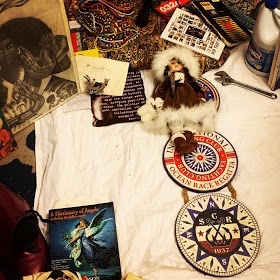
Panda’s apartment wasn’t messy, so much as there was a lot going on. It was a studio with a real big screened- porch connected to it. Her bed was out there. Plugged up, she had 5 box fans and 3 space heaters. There was a desk with stacks of magazines, adhesive, glue sticks, and pieces of scrap wood stacked on top of it. She had several racks of clothes, like in a department store. A clothesline ran from somewhere on her porch to the hook on the back of her front door. There were a few half-finished projects going on, mostly involving wood, paint, and pictures cut from magazines. One work in progress was a picture of a little- girl Panda, plastered on a background of Jiffy cornbread boxes.
The piece that was complete, she had hanging on the wall. It was a mix of painting and collage. Almost floor to ceiling, it was the body of a big booty, big breasted girl, in an outfit like Panda danced in, except this girl had the head of the Virgin Mary. All around her were other girls, or just their breasts or their butts. There were guns, and jewelry, and angels. All of that was framed by a tangle of tree branches.
“I told you,” she said, sounding just a little unsure of herself.
Panda rolled her eyes at me and clicked on the stereo system that was plugged up to a splitter, whose chord ran the length of the apartment and patio. She shut off her overhead lights, clicked another button, and the room was bathed in soft blue and turned on the music. Glow and the dark moons and stars shined as best they could in the dim of the house.
“This makes the mess, a little better, don’t you think?” she asked. “I’ma fix us some drinks. Sit down. Get comfortable. Every spot in here is soft.”
“Sade reminds me of my Mama,” I said as she turned the volume up.
The makeshift sofa, which was made up of two twin mattresses with a few mattress pads stacked on top one another and covered by Bob Marley sheets. Big pillows rested against the wall. It was all bookended by two mismatched end-tables. It was comfortable. The kind of sofa you never wanted to leave. Panda opened up a closet door, which turned out to be a small galley style kitchen. I listened to her clink around behind my back.
When she was done, she came and stood in front me with a tray in her hands.
“Want some?” she asked, nodding down at the tray, and handing me my glass. The Hennessey smelled sweet and strong. She set a pewter and mother of pearl tray on the beat-up coffee table. Then I could see the perfect, parallel, white lines on it.
“I didn’t know you fucked around, I said.”
“Just socially,” Panda laughed. “You here, so this is social.”
“You bought that in Bottoms? That’s Fadi shit. Its good.”
I sat back and let the tangy, sweet tart taste enter my throat. The drip was the best part. I tried to stay away from it but some things it was hard to do sober. I gestured to the tray on my lap.
“I can cook for you. I’m here all day, and most nights.”
“I’m off that.”
She was quiet a few moments.
What the fuck was she talking about? I was Xavier’s people. I didn’t really know who the fuck this girl was, and how she knew who I dealt with, or what she was getting at. People threw crosses all the time to make you vulnerable. I thought about Fadi’s warning, looked at the door, and halfway expected somebody to kick it in. I had done the same thing myself.
“How do you know me and them?”
“So why are you telling me?”
Panda’s bedroom on the porch was everything. With the right combination of the window unit from inside, the box fans, and the one space heater she had turned on low, under her sheets was the perfect temperature. I was wrapped in her and her hair and couldn’t move. It was midafternoon. I didn’t want to.
Panda woke up and asked me to stay. She got out of bed, and I sat back, watched as she opened up her little closet kitchen, and put oranges, cheese, and French bread on the tray from last night. She brought the food over to me, and went in the bathroom, ran some water, and did another bump or two.
I tried to ignore that. She could do what she wanted, but she was right on the edge of where her recreation was turning into work. She came back out with a blunt rolled.
“You should’ve rolled up last night,” I said.
“ You told me you were an artist. What do you do?”
“Draw.” I said fixing my eyes on the scantily clad Madonna. I noticed in the daylight she was holding a child’s hand. A child, who had the body of a skinny dog and walking a lion.
“I think most men worship the woman on my wall.”
“You’re right,” I answered staring at the collaged birds Panda had embedded into the veil of the Madonna.
I had to hit Fadi up, let him know that the plan had gone sour. I had to tell him what this girl said. He had called my phone a million times. We were supposed to meet up with Xavier to pick up our shit the next morning. Kalo and my Dad had called over and over again too, but I couldn’t talk to her or him until things had calmed just a bit. If the shit was true, me and Fadi were going to have to deal with Xavier. The sure way. But first, I would chill out here.
The weed was damn good. We smoked two fat cigars of it back to back, till Panda was able to lie back down. I tossed her ass around. She liked it. She said fucking me was like ballet dancing and tackle football. I bit her on the earlobes and squeezed her on her thighs. Back under her covers, Panda’s bed felt like a womb cut out of the block. It was a place; I could never leave. Lying there face to face, finally too worn out to do it again, there was so much I wanted to say to her. So much to ask. Panda turned on her side, her back to me. I held her tight and waited for some words to fall out of my mouth.
“What do you do if it rains in the middle of the night?” I asked into her neck, finally.
Panda sighed and pressed herself into me. “Nothing. I just lie here, and let it hit me.”

